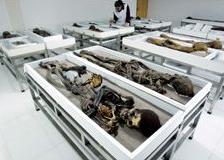
Chinchorro mummies in the San Miguel Museum in Arica city, north of Santiago. Picture / Reuters
by Mennat-Allah El Dorry
Mummification is perhaps synonymous with ancient Egypt. However, ancient Egyptians were not the only culture to have mummified their dead. Perhaps the oldest artificial mummification was performed on Chilean bodies around 5,000 B.C. Some 96 mummies were uncovered accidentally in 1986 near the northern coast of Chile when a water company was digging to install water pipes. The internal organs of these mummies were removed and the insides were filled with straw. The brain was drained out either through holes at the base of the skull, or by splitting the skull in two. The bodies were left to decay to an extent, and later attached by straw and plant fibers. Facial details were painted on, and the genitalia were modeled out of clay. This process of mummification suggests that a statue-like appearance was the aim rather than preservation of the body, which was the ancient Egyptians' main aim for mummification.
It is not only ancient cultures who have mummified their dead, but modern cultures have done the same. One of the examples of modern mummification occurred in January 1924, when the Russian revolutionary leader and creator of the Soviet Union, Vladimir Ilich Lenin, died. Considered a national hero, Lenin's body was mummified and displayed in a special crypt in the Kremlin.
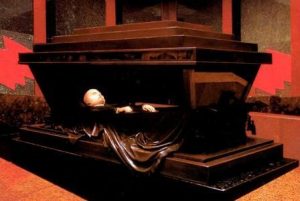
Whilst the Russian government has never released information about how Lenin was embalmed, it is known that every 18 months he is removed from his crypt and immersed in glycerol and potassium acetate as well as other preservatives. He is left to drip the excess liquid before being covered in rubber to retain some of the preservatives. For $250,000 anyone can receive similar treatment courtesy of Moscow's Institute of Biological Sciences which is responsible for the preservation of Lenin.
Yet none of these follow the methods used by the ancient Egyptians. In 1994, a man was mummified the Egyptian way of mummification. Dr. Bob Brier, an Egyptologist from Long Island University and Ronald Wade, Director of the Maryland State Anatomy Board and their team replicated an ancient Egyptian mummification on a human cadaver. The following is an excerpt from Bob Brier's The Mummy Encyclopedia.
'In an attempt to reproduce as closely as possible an Egyptian mummification, replicas of ancient bronze tools were forged with precisely the same metal content (88 percent copper and 12 percent tin) as Egyptian bronze instruments, Because Herodotus said that a 'sharp Ethiopian stone' (obsidian) was used to make the abdominal incision, obsidian blades were flaked for this purpose. A replica of an embalmer's table discovered in 1922 by Egyptologist Herbert Winlock was made for the cadaver to lie on. Natron [a naturally occurring mix of sodium carbonate, sodium bicarbonate and sodium chloride], the dehydrating agent used by ancient Egyptian morticians was obtained at the Wadi El Natrun, the ancient source, fifty miles north of modern Cairo.
The procedure was performed on an unembalmed cadaver of a male who had died at the age of seventy-six. The brain was removed through the nose by breaking the ethmoid bone and extending a hooked rod into the cranium. The rod was then rotated until the brain was broken down into a semiliquid state. Finally, the cadaver was turned face downward, so the brain could run out the nose. For the removal of the internal organs, a 3 ½ inch abdominal incision was made on the left side, using an obsidian blade. Only the heart was left inside the body, as was the ancient Egyptian practice.
'Once the internal organs were removed, the body cavities were washed with palm wine, and both the thorax and abdominal cavity were filled with small packets of natron to absorb the body fluids. The body and separate internal organs were placed on the embalmers' board in a small room, where the temperature (105 degrees Fahrenheit [40.5º C]) and humidity (29 percent) were controlled. Covered with natron, the body and organs remained in the room for thirty-five days. At the end of this period the natron was removed, and the cadaver examined. The body had the appearance of an ancient Egyptian mummy. The hands and feet were dark and hard to touch. There was no smell of putrefaction, and cultures taken from the cranium and abdomen tested negative for bacteria, viruses and fungi. The major difference between the mummy and an ancient one was that some fluids, primarily lipids, remained in the larger muscles, quadriceps, and the gluteus maxima. When the body was placed in natron it weighed approximately 150 pounds, with the organs removed. After 235 days it weighed approx 75 pounds, losing much of its weight due to dehydration.
'The body was anointed with cedar, palm, lotus, frankincense, and myrrh oils and wrapped in pure untreated linen. In an attempt to determine the results of tomblike conditions on a body, that is with some moisture still present, the mummy was replaced in the temp/humidity-controlled room for nearly 5 months. At the end of this period, the mummy had lost an additional 25 pounds of fluids through evaporation. Still there was no odor of putrefaction or evidence of tissue decay. By this time the body had become rigid because of the near total dehydration. When the researchers attempted to cross the arms on the chest, the position of royal mummies, they were unable to bend the arms. This led them to conclude that the goal of the ancient embalmers was not the complete dehydration of the body. Rather, as the modern experimenters had found, after thirty-five days on natron, some moisture remains, and this would have been necessary to manipulate the position of the mummy for wrapping. The final dehydration could then occur in the tomb.
'The mummy has been examined by CAT scans and MRI (magnetic resonance imaging) to determine its condition; tissue is periodically sampled and analyzed to monitor the state of cell preservation. The mummy remains in storage at room temperature at the Medical School of the University of Maryland.''
Whether this modern mummy lasts some 7,000 years or not, well, none of us will find out! A documentary of this modern attempt is available, and I highly recommend it to those who are strong-of-heart!
There is a lot more to know about mummies, and if you would like to read further, I recommend Bob Brier's 'The Encyclopedia of Mummies', 2004, of which the above excerpt comes. It is very well written, and arranged in a very comprehensible manner.